One Mouth, Two Different Problems
Most people who come in about missing teeth expect a straight choice, dental implants vs dentures, one or the other, Brisbane dentists explain. A patient we saw recently was a good example of why it’s not always that simple. She had several teeth missing across the top, and one gap low on the bottom right. Two different problems, same mouth. Fixing both the same way would have done neither of them justice. So the plan split in two: a removable denture up top, a single implant down the bottom. One patient. Two answers. Because the gaps weren’t the same. Here’s how that decision actually gets made.

The Plan Our Brisbane Dentist Chose
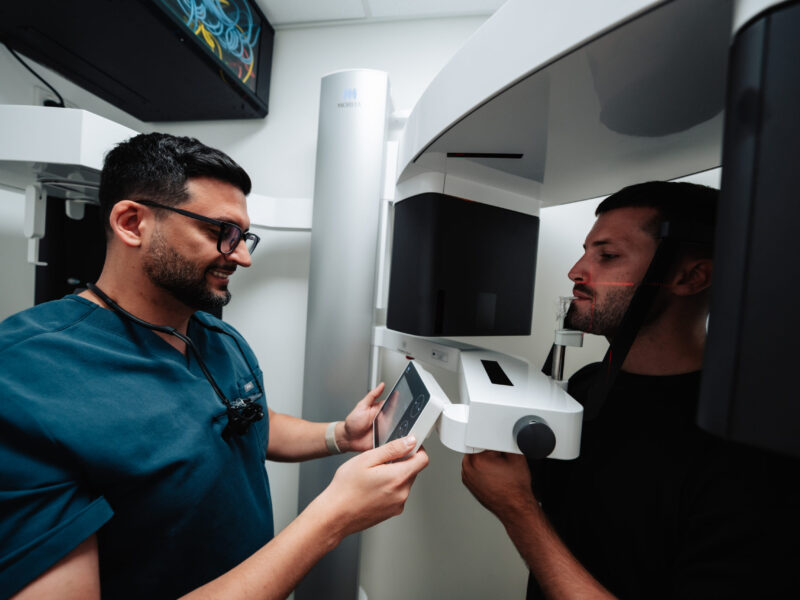
The top and the bottom should be handled differently, and that is deliberate. Up top, our dentist planned a removable partial denture, a slim plate that clips in and out and fills the run of missing upper teeth in one go. Straightforward, and the right call for a bigger gap. The bottom is a different piece of work. That single lower-right gap suits one implant, and it runs in stages. First, a 3D scan (a CBCT) to see how much bone is actually there and where the nerve sits. Then, a surgical guide, basically a custom stencil that tells the dentist the exact spot and angle to place the implant. The bone at that site is a bit thin, so a small graft should go in at the same time to give the post something solid to hold. Then the wait. An implant needs a few months to knit into the bone osseointegration, if you want the technical word, before it can take any real load. Once it has, the abutment (the connector) goes on, and a crown goes on top: the part that looks and chews like a tooth. The end result will be a plate our patient will take out at night up top, and one fixed tooth that stays put down below. Same mouth, two completely different fixes.
Why a Denture Suited the Upper Teeth
A denture makes sense up top for one straightforward reason. It rebuilds a whole run of missing teeth in a single removable appliance, without putting an implant into every empty space, which keeps both the surgery and the cost down. Her upper plan used an acrylic partial denture. In plain terms, that’s a lightweight plate that carries the replacement teeth and clips onto the natural teeth she still has. The base is made of dental acrylic (resin), which is the quicker and more affordable style of partial denture. It brings back chewing and the look of a full smile without a separate procedure at each gap. Here’s the bit that surprises most people. You don’t need one implant for every missing tooth. But replacing a wider span with implants still means several of them, or an implant-supported bridge, and each implant comes with its own surgery, healing time, and cost. For a broader gap like hers up top, that’s a lot of treatment to solve something a single denture handles well. The denture is simply the right tool for the bigger space.
Why a Single Implant Suited the Lower Tooth
Down the bottom, one implant is the better answer for a simple reason: the gap sits on its own. An implant stands alone. A small titanium post goes into the jawbone and becomes the root for a single crown, so it doesn’t lean on the teeth beside it for support. That’s the whole appeal for a lone gap. The usual alternative for one missing tooth is a fixed bridge. A bridge works by crowning the two teeth either side of the space and hanging a false tooth between them. To do that, those two teeth have to be filed down first, even when there’s nothing wrong with them. That’s the part people don’t always hear about. An implant leaves them untouched. When the teeth on either side are sound and don’t need crowning for any other reason, keeping them whole is usually the better long-term call.
Her plan also includes a small bone graft at the site. A graft goes in when there isn’t quite enough bone to hold an implant firmly, so a little is built up first to give the post a stable base. It’s part of why the 3D scan comes first. You want to know what the bone is doing before anything is placed.
Dental Implants vs Dentures: What Each Is Like to Live With
If you’re comparing dental implants vs dentures, the difference that matters most is an everyday one: an implant stays fixed in your mouth and feels close to a natural tooth, while a denture lifts out at night and takes a few weeks to settle into. Most of the rest, the chewing, the feel, the cleaning, follows from that.
Here’s how it plays out day to day, once everything’s healed and settled.
- In or out of your mouth: A denture is removable. It clips in for the day and comes out at night to be cleaned and to give your gums a rest. An implant is fixed in place and stays put, so you treat it as part of your mouth. Most of our patients report that this is the difference they notice first.
- How it feels day to day: Because an implant is anchored in the bone, it feels much like a natural tooth, and most people simply forget it’s there. A denture rests on the gum, so it can feel bulkier to begin with and takes a little while to get used to. Most people settle in within a few weeks.
- Eating and chewing: A fixed implant lets you bite and chew close to normal. A denture brings back a good deal of your chewing, though usually not the full strength of natural teeth, and firmer or stickier foods can take some practice, especially in the first few weeks.
- Cleaning and upkeep: You look after an implant crown much like your own teeth, with regular brushing and cleaning around the gumline where it meets the implant. A denture comes out to be cleaned with a denture brush and soaked, then goes back in. Keeping the gum around an implant clean genuinely matters, because trapped plaque can inflame the gum and, left unchecked, affect the bone that holds the implant, a problem dentists call peri-implant disease.
- How long each one lasts: With good care and healthy gums, an implant is built to last many years, and for a lot of people, that means well over a decade, though the crown on top can wear and may need replacing before the implant itself does. A denture doesn’t stand still either. The mouth slowly changes shape underneath it, so a denture usually needs relining or remaking at some point to keep fitting well.

What About a Denture That Clips Onto Implants?
A third option sits between those two. Rather than resting on the gum alone, a denture can be built to clip onto a couple of implants placed in the jaw. The implants act like studs, so the plate snaps on, holds firm, and still lifts out for cleaning. People often look at this when a lower denture keeps working loose, because the bottom jaw gives a denture less to hold onto in the first place. This wasn’t what the patient in this article had. Hers were two separate fixes, a standalone denture on top and one implant on the bottom, not a denture anchored onto implants. It’s just another route some people weigh up, and like any implant option, it comes down to having enough healthy bone and gum to support it, which a scan and an assessment would sort out first.
If You’re Nervous, Here’s How We Keep You Comfortable
Most single implants are done comfortably with local anaesthetic alone. If you’re anxious or you’re having more done in one go, you can add three levels of sedation on top, if you are eligible. Here’s what each one is actually like:
- Happy gas (nitrous oxide): The lightest option. You breathe laughing gas through a small nosepiece; it takes the edge off within minutes, and it clears almost as quickly once you stop, so most people can drive themselves home. You stay awake and aware the whole time, just more relaxed.
- IV sedation: IV sedation is a step deeper. It is also sometimes called twilight sedation. A sedative goes in through a small drip in your arm, and you settle into a relaxed, dream-like state where you’re not unconscious but drowsy and often remember little of it afterwards. You’ll need someone to drive you home and stay with you for the rest of the day.
- Sleep Dentistry in Brisbane: You will be fully asleep under general anaesthesia for the whole procedure. This one happens in a hospital or day-surgery setting rather than our chair, with a specialist anaesthetist looking after you. It involves fasting beforehand and a pre-anaesthetic assessment, and someone needs to take you home. It’s generally reserved for significant dental anxiety, special needs, or when a lot of treatment is being combined into a single visit.

Frequently Asked Questions
Is an implant better than a denture?
Neither one is automatically better; the right answer depends on your mouth and what you need. An implant is fixed in the jaw and feels closest to a natural tooth, so it often suits a single gap where the bone and gums are healthy, while a denture is removable and can be a more practical and affordable way to replace several teeth at once. The better option is simply the one that fits your own teeth, gums, bone and budget, which a proper exam and a 3D scan can settle.
Do dental implants hurt?
Not usually, no. The site is fully numbed with local anaesthetic first, so while the implant goes in, you feel pressure and some movement, not pain. For a lower tooth like this one, the numbness reaches your lip and one side of your tongue, and that fat, clumsy feeling for an hour or two is what catches most people off guard. So it’s not the implant, it’s the numbness. The soreness comes later, and we’d rather be straight about it. Once the numbing wears off, expect some tenderness and light swelling, much like after a tooth out. It peaks in a day or two, then eases over the week.
Do dentures damage other teeth?
Not on their own, but a partial denture does rest on the teeth beside it, so those teeth need looking after. If plaque is left to build up around the clasps that hold the denture, it can lead to decay and gum problems in the supporting teeth over time. Cleaning both the denture and your own teeth well, and having the fit checked at regular reviews, is what keeps that risk low.
Can you have dentures and implants together?
Yes, and seeing both in the same mouth is common. That can mean two separate fixes, a denture replacing teeth in one area and an implant replacing a tooth somewhere else, or it can mean a single denture built to clip onto a couple of implants so it sits more firmly. Which arrangement suits you comes down to how many teeth are missing and where, along with the bone and gum supporting them.
How long does a dental implant last?
With good care and healthy gums, a dental implant can last many years, and for a lot of people, that means decades or longer. The titanium post is designed as a long-term fixture, though the crown attached on top can wear over time and may need replacing before the implant itself does. What matters most is keeping the gum and bone around it healthy, because plaque left to build up can lead to peri-implant disease and, over time, put the implant at risk, so daily cleaning and regular check-ups genuinely count.
Can I use my super to pay for dentures or implants?
Sometimes, yes. Through the ATO’s early release of super on compassionate grounds, some patients use their own superannuation to help pay for major dental work such as dentures or implants, and a service like SuperCare can prepare and lodge the application with the ATO. Keep in mind it’s your own super being released early rather than a loan or a health-fund rebate, the ATO approves it case by case and usually only where the treatment is genuinely needed rather than cosmetic, and because it isn’t automatic, this counts as general information rather than financial advice, so check your eligibility before relying on it.