If gum disease has loosened your front teeth, that does not mean that you will necessarily lose them. Tooth splinting is one of the ways Brisbane dentists can hold your teeth in place while your gums are treated. A splint is a simple thing; it’s a thin fibre or wire that dentists bond behind the loose teeth and the neighbouring teeth that are firm and steady. Once we join the teeth together, your loose teeth will stop moving and wobbling on their own. Most patients find that chewing feels much steadier after tooth splinting. Please remember that a splint doesn’t treat the gum disease, and it doesn’t bring back bone that’s already lost. A 2022 review for the European Federation of Periodontology concluded, from limited evidence, that splinting on its own does not make loose teeth last longer. So a splint only does one job: it holds the teeth you have in place.
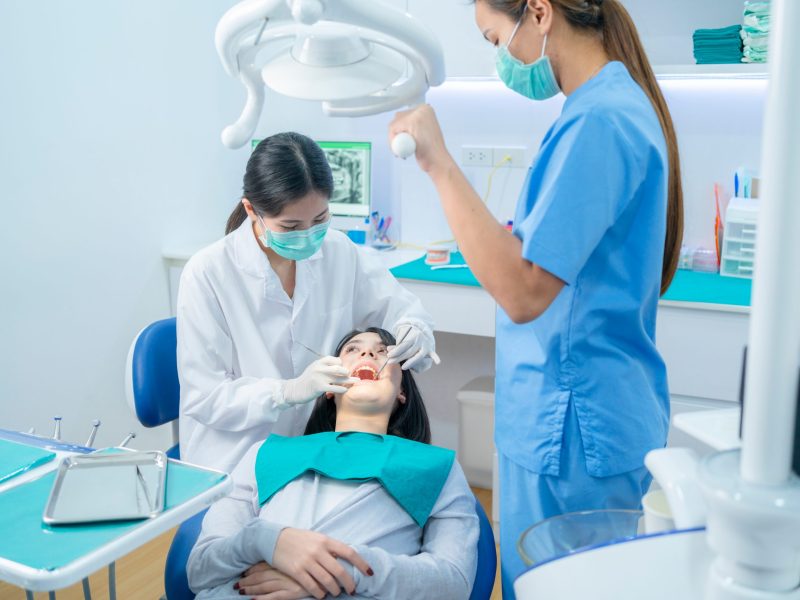
Why do front teeth loosen with gum disease?
You may wonder, it’s “gum” disease, so why does it affect my “teeth”? The problem is that gum disease can gradually destroy the bone and ligament that hold each root in place. Once a root is affected, the tooth has less bone to hold onto, and it starts to loosen. You may be surprised to hear that loose teeth caused by gum disease usually begin with plaque building up along the gumline. When plaque is left there for years, it can work its way down the root, and the body’s attempt to fight the bacteria slowly breaks down the bone around it. This usually does not hurt in the early stages, which is why many people first notice a problem when a tooth starts to move. Healthdirect puts moderate to severe gum disease, known as periodontitis, at three in ten Australian adults.
Our front teeth, especially the bottom ones, have small roots, so they are usually the first ones to loosen, and once they are loose, they often begin to drift apart as well. In adults, loose teeth from gum disease are far more common than loose teeth from an injury or heavy grinding.
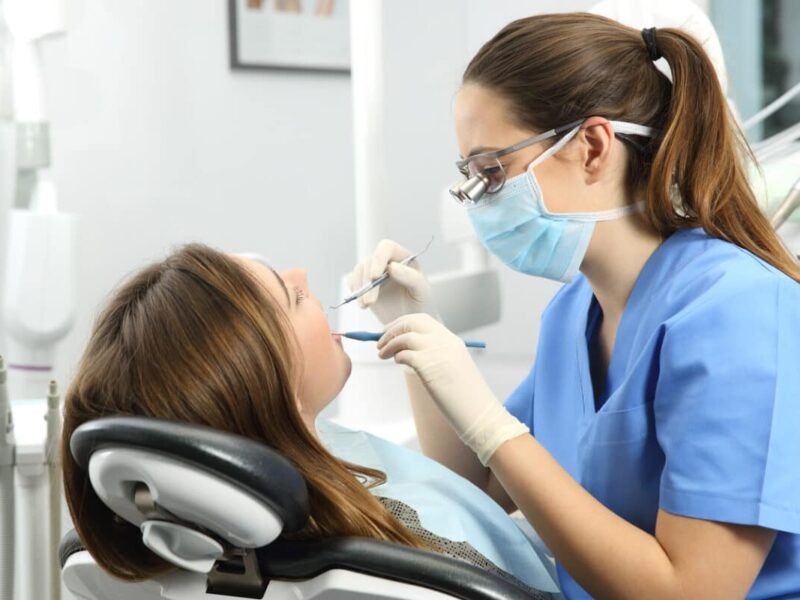
What tooth splinting does not do
A splint has limitations that we explain below:
It does not treat the gum disease
The bacteria under the gum keep destroying bone, whether the teeth are joined or not, and a splint placed over that inflammation makes the area harder to keep clean. Specialist reviews list untreated disease as a reason not to splint. The real treatment is cleaning the root surfaces under the gum, known as scaling and root planing, surgery in some cases, and maintenance visits for years afterwards. We can fit a temporary splint early on to make the gum treatment easier to get through, something the European guideline leaves room for, provided the gum treatment itself still gets done. If you find the deep cleaning hard to sit through, it can be done under IV sedation.
It does not bring back bone
Bone that is already lost due to gum disease cannot grow back on its own, and a splint won’t change that. Regenerative gum surgery is a separate decision for the dentist or periodontist, and it can sometimes rebuild part of the lost bone, depending on the shape of the defect.
It does not make the tooth itself firmer
Older studies from the late 1970s found mobility dropped while the splint was on and came back when it was removed. The exception is looseness caused by inflammation, which can settle once the gums are treated. In the Heidelberg trial, gum treatment on its own settled the teeth of two people who were supposed to be splinted afterwards, and they never got a splint.
It has not been shown to make teeth last longer
The 2022 review mentioned earlier could only find two studies that looked back over patient records, and neither could show that splinting makes teeth last longer. The same Heidelberg group kept track of 162 splinted lower front teeth for three years and did not lose one. Every patient in that study was also having regular gum maintenance, though, and nobody can say how much of the result came from the splint and how much from the maintenance.
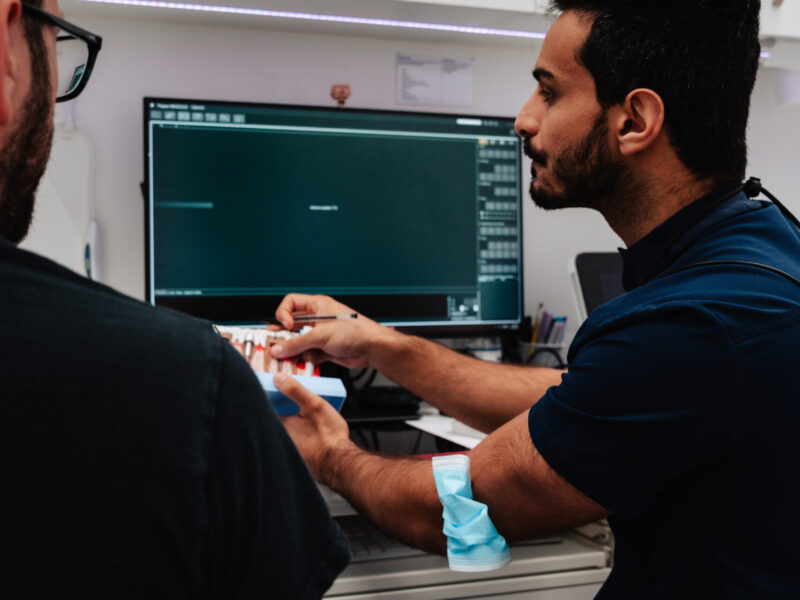
Does splinting help the gums heal?
So far, no study has shown that a splint makes any difference in how the gums heal. Every time you bite on a wobbly tooth, you disturb the gum that is trying to reattach to the root, and that is why people expect a splint to help. In the Heidelberg trial, people with loose lower front teeth had a splint fitted either before their gum treatment or seven months after it, and a year later, the gum measurements in the two groups were about the same. A 2025 study looked at splinting during regenerative gum surgery and found no added benefit for teeth that were only slightly loose or not loose at all. A new trial registered in February 2026 is testing the question directly. Adults with advanced gum disease and loose lower front teeth get a wire splint a week before gum surgery, or no splint, and six months later, the researchers will count how many gum pockets have healed. Until those results come out, the reason to have a splint is that your teeth stop moving, and you can chew properly again.
How long does a splint last?
A fibre splint usually lasts for years. In a German study of 162 splinted lower front teeth, three out of four splints were still intact after three years, and not one tooth was lost, while a Ukrainian study of 58 people found two out of three still intact, with smokers and people with diabetes doing worse. If a splint comes loose, it is usually just one part that has come unstuck, most often after biting into something hard. We glue it back on in one visit. The gum care underneath the splint decides how long it lasts. Everyone in the German study was having gum maintenance every three to twelve months, as the European guideline recommends, and we check the splint at each of those visits.
When a loose front tooth is past splinting
A loose front tooth is past splinting when too little bone is left around the root to keep it, when the neighbouring teeth are too loose to act as anchors, when the gum disease cannot be brought under control, or when the area cannot be kept clean. Dentists also look at the bite, because heavy grinding puts a lot of force on a splint and keeps breaking it. Joining three wobbly teeth together only makes one larger wobbly unit, and the European guideline reserves splinting for teeth that can be kept. Once a tooth is past that point, it usually comes out and is replaced, most often with an implant or a denture.
If you would rather be asleep for the extraction, we offer sleep dentistry in Brisbane, which we do under general anaesthesia in hospital.
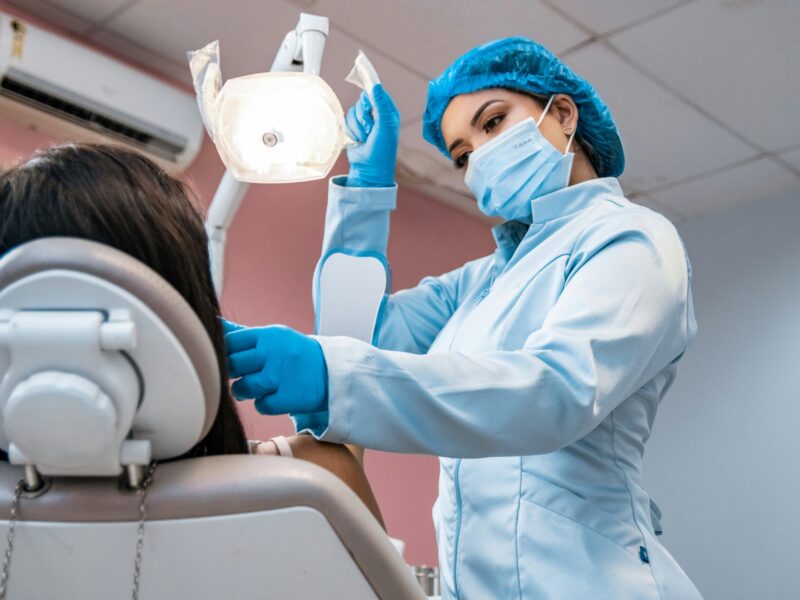
Looking after splinted teeth
Clean your splinted teeth just the way you clean the rest of your teeth, with one change: ordinary floss can’t get down between teeth that are joined at the back. You should use a floss threader to get the floss in under the splint, or a small interdental brush pushed in from the front. The tongue side of the splinted teeth needs careful brushing, because the splint is on that side and plaque builds up along its edges. Cut hard foods like apples and crusty bread into pieces instead of biting into them with your front teeth, because that and chewing gum are the usual reasons a section comes unstuck. Make sure you don’t skip your maintenance visits. The European guideline calls these visits supportive periodontal care and says they should be anywhere from three months to a year apart, depending on how high your risk is. We check the splint on every one of them and clean around it. If the splint comes off one tooth, you shouldn’t leave it that way or try to fix it yourself. That tooth is now unsupported and has nothing to hold it, and food and plaque can get stuck in the gap. Give us a call and book a visit so that we can re-bond it 07 3343 4869. The visit is usually a short one.
What happens at the first visit
The first visit is an examination and x-rays, and no one can tell you whether a splint will work before that. We measure the gum pockets around each loose tooth and take X-rays to see how much bone is left around the roots. That is what decides whether the tooth can be kept. If gum disease is active, treating it is our priority, and a splint is usually planned once we can see how the teeth settle. Some teeth firm up enough after gum treatment that they do not need a splint. The cost of tooth splinting is quoted per tooth, so it depends on how many teeth are joined, and we give you the figure after the exam.
Tooth splinting after an injury
If your tooth has been knocked out or loosened, the splint we use will be different. In those situations, we use a soft and flexible splint that stays on for just two weeks, or four weeks for some displaced teeth and root fractures. It is there to hold the tooth still in the right position until the ligament around the root has healed.
Please remember that time matters more than anything else with these injuries, so if a tooth has been knocked loose or out, call our emergency dentist Brisbane the same day.
Is tooth splinting painful?
We glue the splint onto the enamel on the back of your teeth, so in most cases, nothing gets drilled, and you don’t need an injection. For a few days, your teeth may feel a little sensitive, and your tongue will probably keep going to the new surface, but both wear off on their own. If dental visits make you nervous, you can have laughing gas while the splint goes on.
Is tooth splinting permanent?
If the splint is for teeth loosened by gum disease, it stays on for years. As long as the teeth are being kept and the gum disease stays under control, the splint stays, and we repair it when a section comes loose and replace it when it wears out. A splint used after an injury is short-term and comes off after a few weeks. Either way, the tooth usually won’t be any firmer once the splint is gone.
Can loose teeth tighten again?
Teeth that are loose because of inflamed gums can firm up once the gums are treated, and in one trial, two people who were booked for a splint ended up not needing one. Teeth that are loose because of lost bone usually stay loose. A splint holds them steady, but the looseness underneath does not change.
Can I eat normally with a tooth splint?
After the first few days, you can eat normally, but you may need to change one thing in your eating routine, and that’s biting into hard foods with your front teeth. Cut them into pieces instead. It’s best to avoid chewing gum and sticky sweets because they pull at the edges of the splint.

References
- Dommisch H and colleagues. Efficacy of tooth splinting and occlusal adjustment in patients with periodontitis exhibiting masticatory dysfunction: a systematic review. Journal of Clinical Periodontology, 2022. https://doi.org/10.1111/jcpe.13563
- Herrera D and colleagues. Treatment of stage IV periodontitis: the EFP S3 level clinical practice guideline. Journal of Clinical Periodontology, 2022. https://doi.org/10.1111/jcpe.13639
- Sanz M and colleagues. Treatment of stage I to III periodontitis: the EFP S3 level clinical practice guideline. Journal of Clinical Periodontology, 2020. https://doi.org/10.1111/jcpe.13290
- Sonnenschein SK and colleagues. The impact of splinting mobile mandibular incisors on oral health-related quality of life: preliminary observations from a randomized clinical trial. Journal of Clinical Periodontology, 2021. https://doi.org/10.1111/jcpe.13454
- Sonnenschein SK and colleagues. The impact of splinting timepoint of mobile mandibular incisors on the outcome of periodontal treatment: preliminary observations from a randomized clinical trial. Clinical Oral Investigations, 2022. https://doi.org/10.1007/s00784-021-04075-4
- Sonnenschein SK and colleagues. Long-term stability of splinted anterior mandibular teeth during supportive periodontal therapy. Acta Odontologica Scandinavica, 2017. https://pubmed.ncbi.nlm.nih.gov/28643542/
- Evaluation of fibre-reinforced composite splinting of mobile lower front teeth in patients with periodontitis. Zaporozhye Medical Journal, 2022. https://doaj.org/article/94599c84590742359353577b4dee59e4
- Effect of tooth splinting on clinical outcomes following periodontal regenerative therapy in teeth with mobility degree 1 or 0: a propensity score-matched analysis, 2025. https://pmc.ncbi.nlm.nih.gov/articles/PMC12377938/
- ISRCTN registry. Can temporary tooth splinting improve healing after gum surgery in patients with severe gum disease? (SPLINT-PERIO), registered 2025. https://www.isrctn.com/ISRCTN12669458
- Martinez-Canut P and colleagues. A study on factors associated with pathologic tooth migration. Journal of Clinical Periodontology, 1997. https://pubmed.ncbi.nlm.nih.gov/9226390/
- Baburaj and Dixit. Analysis of spontaneous repositioning of pathologically migrated teeth: a clinical and radiographic study. Quintessence International, 2014. https://quintessence-publishing.com/usa/en/article/840777/quintessence-international/2014/09/analysis-of-spontaneous-repositioning-of-pathologically-migrated-teeth-a-clinical-and-radiographic-study
- Mosedale RF. Current indications and methods of periodontal splinting. Dental Update, 2007. https://www.dental-update.co.uk/content/periodontics/current-indications-and-methods-of-periodontal-splinting
- Fouad AF and colleagues. International Association of Dental Traumatology guidelines for the management of traumatic dental injuries: 2. Avulsion of permanent teeth. Dental Traumatology, 2020. https://doi.org/10.1111/edt.12573
- Healthdirect Australia. Gum disease. https://www.healthdirect.gov.au/gum-disease
- Cambridge University Hospitals NHS Foundation Trust. Caring for your mouth after a dental injury, patient information leaflet. https://www.cuh.nhs.uk/patient-information/caring-for-your-mouth-after-a-dental-injury/
- Australian Dental Association. Schedule and glossary Q&A on item 981, splinting and stabilisation. https://ada.org.au/ada-schedule-and-glossary-qa-9-orthodontics-general-services-misc